


Japanese automaker Nissan posted a positive operating profit for fiscal year (FY) 2025. This achievement was reached despite continued global economic pressures, signaling early gains from its ongoing Re:Nissan recovery strategy.
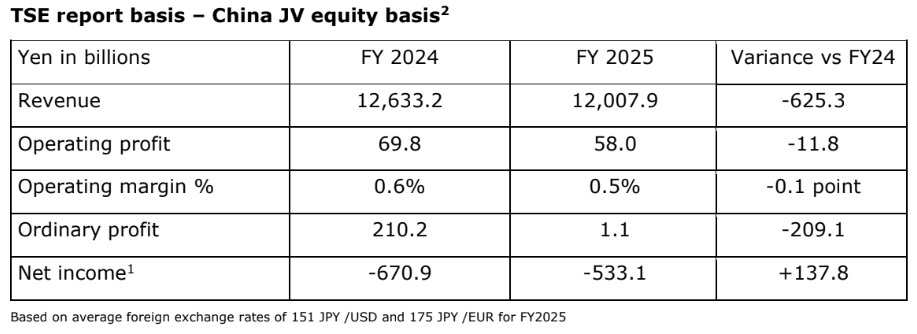
In its latest financial report released on May 13, Nissan said it achieved an operating profit of ¥58 billion (or P22,572,689,400 in today’s exchange rate) for the fiscal year ending March 31, 2026, alongside consolidated revenue of ¥12 trillion (or roughly P4,670,594,400,000). Global sales reached 3.15 million units as the company navigated inflation, tariffs, currency fluctuations, and uneven market conditions across key regions.
While Nissan still reported a net loss of ¥533.1 billion (P596,744,763,860.00 in Philippine money), the company highlighted improving momentum during the second half of the fiscal year. Automotive free cash flow turned positive at ¥112 billion (P43,594,969,600 in local currency) in the latter half, helping soften the full-year negative cash flow figure of ¥480.8 billion (or P187,129,715,919.99 in today’s exchange rate). Below is a summary of Nissan’s FY2025 financial performance compared to FY2024.
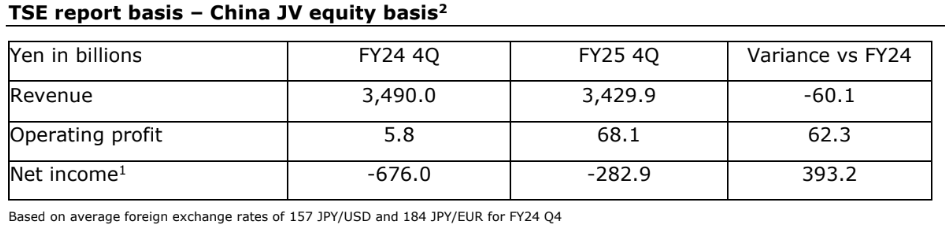
The report also showed stronger fourth-quarter performance. Nissan recorded fourth-quarter operating profit of ¥68.1 billion (about P26,502,912,840), significantly higher than the ¥5.8 billion (around P2,257,375,080) posted in the same period the previous fiscal year. Quarterly net loss also narrowed to ¥282.9 billion (nearly P110,114,043,990). The following table outlines Nissan’s fourth-quarter financial results and year-on-year improvements.

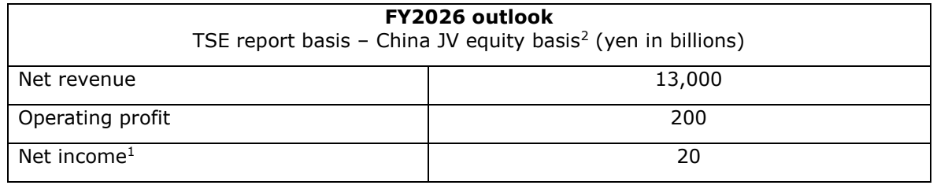
Looking ahead, Nissan projects a more stable FY2026. The automaker forecasted ¥13 trillion (P5,059,938,000,000) in net revenue, ¥200 billion (or P77,847,560,000 in local conversion) in operating profit, and a return to positive net income at ¥20 billion (approximately P7,784,717,999). However, it also confirmed that no dividends are planned for FY2026. Nissan’s outlook for FY2026 reflects the company’s push toward profitability under its Re:Nissan transformation plan, which is outlined in the table below.

The company said cost-cutting initiatives remain central to its recovery efforts. Nissan reported progress toward its ¥500 billion (P194,614,250,000 in today’s local exchange rate) cost reduction target, while also moving to consolidate its global manufacturing footprint from 17 plants to 10. Chief Executive Officer Ivan Espinosa said Nissan is now transitioning from recovery to a phase of growth, backed by tighter cost management and faster product execution.
Autocar’s Take
Nissan’s latest financial results do not paint a perfect picture, but they do show signs of a company regaining control after several difficult years. The numbers remain challenging, especially the large net loss, yet the improvement in operating profit and second-half cash flow suggests the Re:Nissan strategy is beginning to stabilize the business.
More importantly, Nissan is now focusing on discipline, as opposed to just short-term headline gains alone. Factory consolidation, tighter inventory management, and sharper market targeting may not sound exciting, but these are the kinds of decisions that determine long-term survival in today’s fiercely competitive automotive industry.