
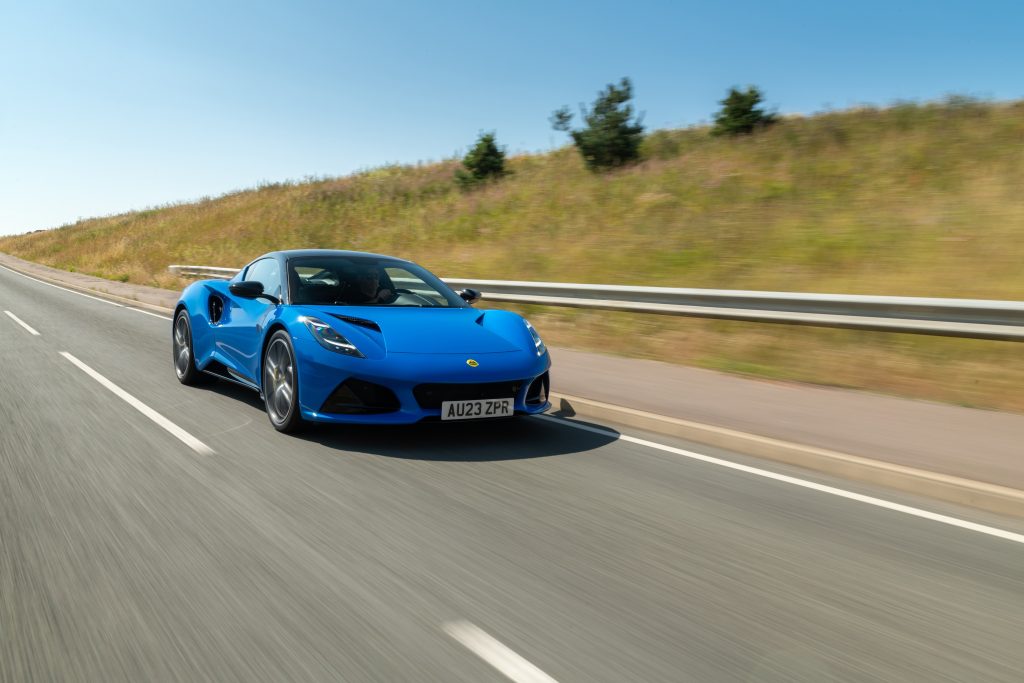
 The Lotus Emira first held its global debut two years ago along with an announcement that it would be the brand’s final mainstream Lotus two-seater that is powered by an internal combustion engine. The Emira was unveiled with a 3.5-liter supercharged V6 powerplant mated to either a six-speed manual or automatic transmission.
Recently, the British marque launched an update for their award-winning sports car model, a four-cylinder engine option.
Lotus unveiled the new Lotus Emira powered by a turbocharged 2.0-liter four-cylinder engine. The new Emira powerplant is supplied by Mercedes-AMG based on the world’s most powerful four-cylinder engine in series production.

 A special edition model ushers the official launch of the new Lotus model – the Emira First Edition. The special launch edition model sports uprated intake and exhaust system in addition to a one-off tuning match to a new transmission shift-mapping. The Emira First Edition’s lightweight, strong, stiff, bonded, and extruded aluminum chassis structure is driven by 365ps of power and 430Nm torque making it worthy to be hailed as the most powerful four-cylinder to ever come out of the Lotus production line.
Mike Johnstone, Group Vice-President and Chief Commercial Officer, Lotus, said: “The Emira V6 has already proved incredibly successful, with many thousands of orders received from around the world. Now, with the four-cylinder Emira joining the range, we’re adding a new dimension to the car’s breadth of capability and appeal, offering new levels of efficiency and accessibility while continuing to offer all the performance and agility that our customers expect.”
 Designed solely for high-performance applications, the 1,991cc engine features a cylinder block produced using the advanced chill-casting process: compared to conventional sand-casting methods used in high volume applications, this results in a uniform, fine-grained structure which delivers the high strength and durability needed to withstand the high loads generated. Following motorsport practise, the block is also of closed-deck design for maximum stiffness, and instead of conventional cast iron liners, the cylinder bores use a patented low-friction coating to save weight. For the optimal balance of high strength and low weight, both the steel crankshaft and aluminium pistons are forged.
The cylinder head features four valves per cylinder and a 200bar direct injection system. Intake and exhaust cams feature variable valve timing, while on the exhaust side, the valves can be varied between high and low duration. The piezo injectors deliver fuel into the combustion chamber with very high precision, both in terms of the amount of fuel and the spray pattern, resulting in enhanced combustion with reduced emissions. For maximum power, the piezo injectors are joined by the port fuel injectors, mounted directly on the intake side of the cylinder head to deliver the correct amount of petrol needed at full load.
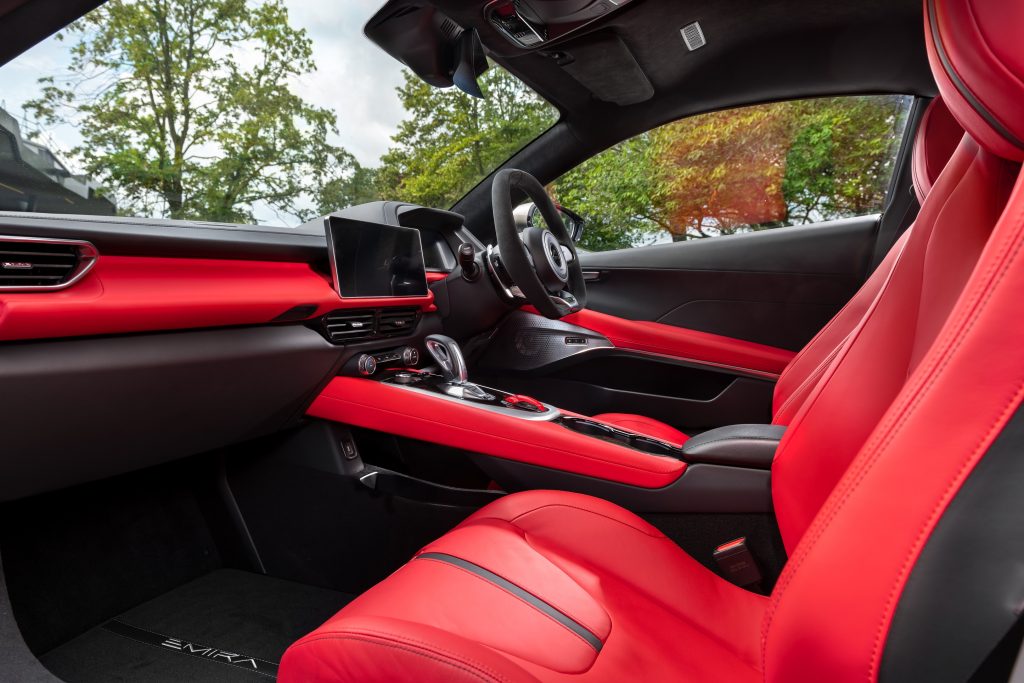 The turbocharger is a ‘twin-scroll’ design, meaning the turbine housing is split into two separate ducts, matched to corresponding ducts in the exhaust manifold. This minimises exhaust gas pulsation interference, helping to improve the efficient exchange of gases in the cylinders. It also ensures that boost pressure builds up more rapidly, and to further enhance responsiveness, the shaft joining the compressor and turbine wheel runs in ultra-low-friction roller bearings. To manage boost pressure most effectively, the wastegate is electronically controlled.
This combination of advanced technologies, together with intake and exhaust systems developed by Lotus and optimised with a unique in-house calibration, ensure this remarkable engine can deliver an astonishing balance of power, torque and efficiency throughout its full operating range. Generating 430Nm from 3,000-5,500rpm and 360bhp (365PS) at 6,600rpm before reaching a maximum speed of 7,200rpm, it ensures an authentic Lotus sports car driving experience while also being refined in day-to-day use.
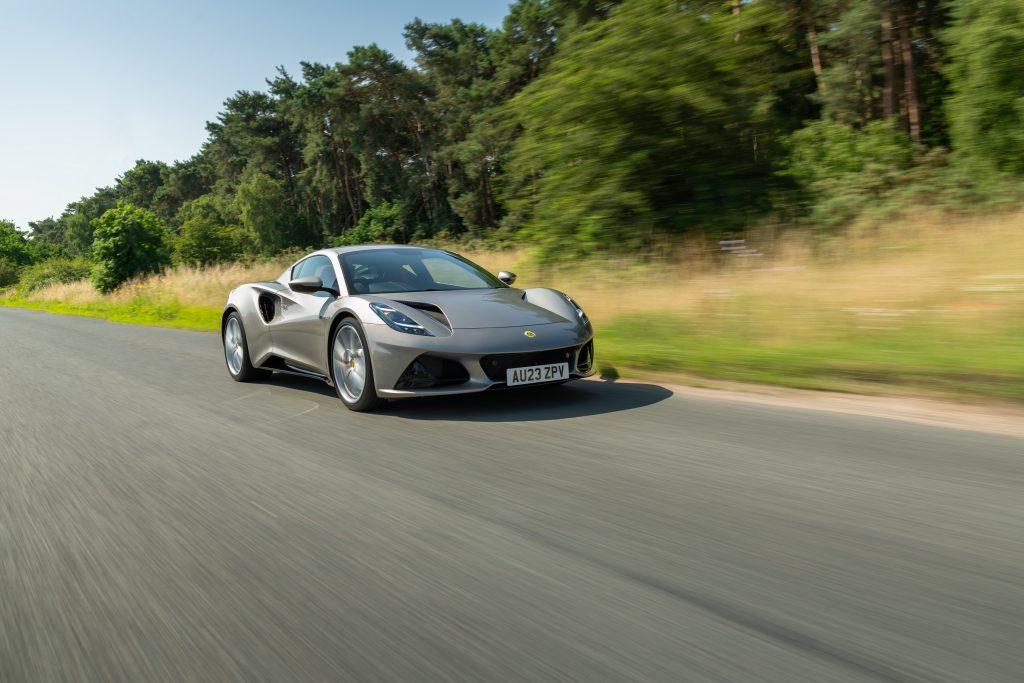 Sending drive to the rear wheels is Mercedes-AMG’s acclaimed eight-speed dual-clutch transmission (DCT) – a first use of the technology by Lotus and fitted exclusively to the Emira. Compared to the six-speed manual and automatic transmissions offered on the Emira V6, the DCT offers even quicker gearchanges with no torque interruption during shifting, enhancing efficiency and shift comfort. Drivers also have the choice of smooth, effortless changes if they leave the car in Drive, or ultra-fast dynamic changes if they control the transmission themselves using the shift lever in the centre console or steering wheel paddles.
Launch control enables the driver to set the car up for optimum acceleration from a standing start by maximising the available traction from the rear wheels and torque from the powertrain. This feature enables consistent, optimal get-aways – time and time again – allowing the driver to fully exploit the Emira’s exhilarating performance.