

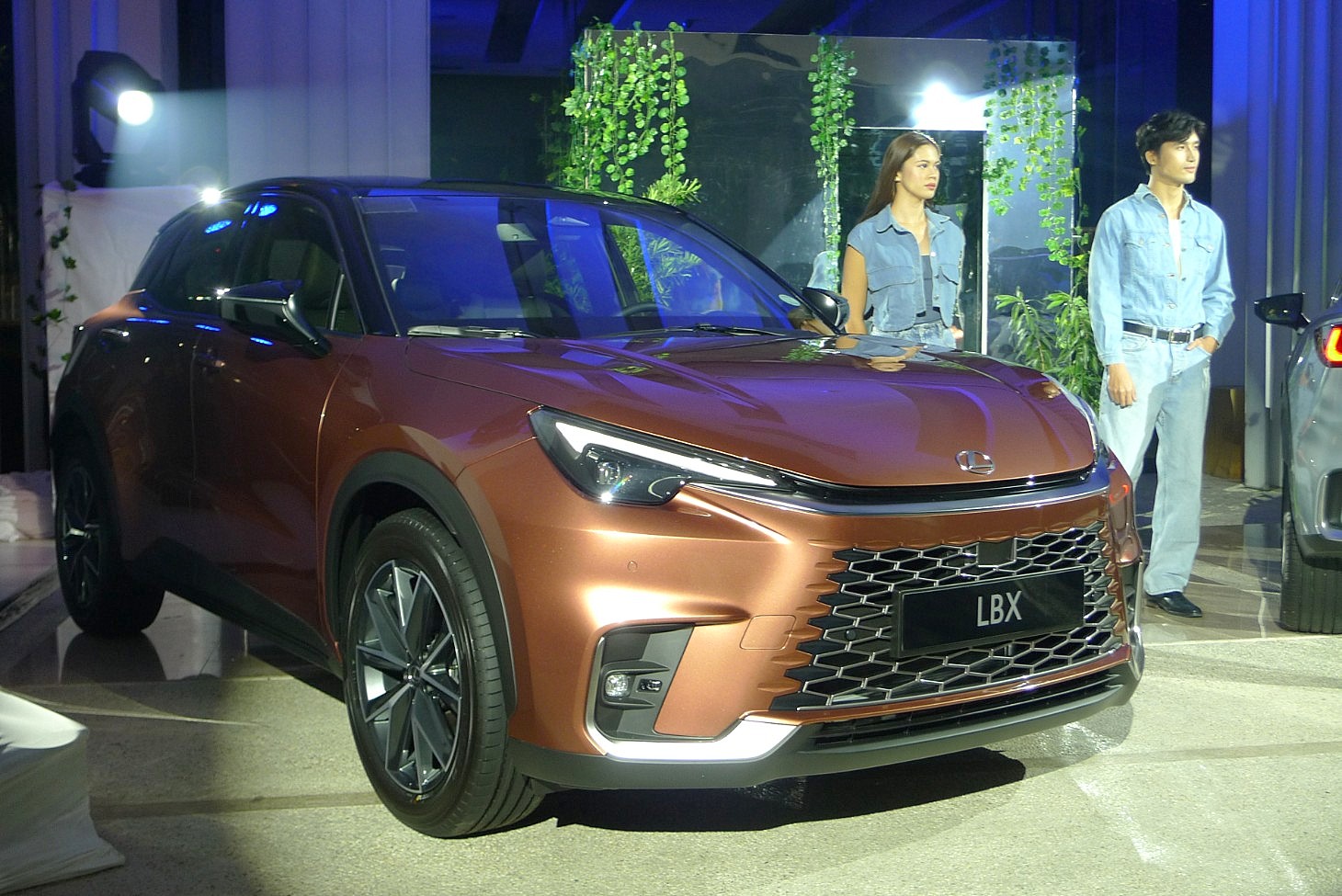
The LBX is an all-new model for a new market for Lexus. It is set to be a game changer that embodies all of Lexus’ values of authenticity, refinement, omotenashi, engaging and imaginative technology.
The smallest Lexus yet, the LBX is a self-charging hybrid electric crossover that’s designed to be accessible and easy to live with, in tune with contemporary style thinking that combines high quality with a casual feel. It offers much more than might be expected from a car in its class, embracing advanced technologies and making no compromise in the distinguishing Lexus qualities of luxury craftsmanship and Omotenashi hospitality for everyone on board.
The use of a three-letter name is significant – previously only the LFA supercar has enjoyed that distinction. The choice of the name LBX demonstrates Lexus’ commitment to and trust in its new model. Just as the LFA showed a different side to the brand in terms of attitude and performance, so the LBX will challenge the status quo and redefine what a small car can offer, energising and expanding the brand’s reach and profile.
As a new entry point to Lexus’ model range, it offers strong appeal to a younger audience and those who may not have considered a Lexus before. It will also be an attractive proposition to those seeking to downsize or purchase a second vehicle, meeting their evolving lifestyle requirements.
Chief Engineer Kunihiko Endoh comments: “Our aim was to challenge the conventional concept of a luxury car. We have thoroughly pursued a driving experience that enables a natural dialogue between the driver and their vehicle and a design that has a refined presence.”
The driving experience is central to the LBX’s customer appeal and extensive efforts have been invested to ensure the constant control, comfort and confidence of the Lexus Driving Signature are delivered in a small car package. The package of fundamental measures includes fundamental revisions to the GA-B global platform, lengthening the wheelbase, widening the track and increasing body rigidity. Packaging, suspension tuning, braking and steering all play their part in producing a car that responds instantly and faithfully to the driver’s inputs.
The new powertrain, a self-charging 1.5-litre hybrid electric system, is tuned for rewarding performance, with powerful, linear acceleration from start-up. This helps deliver low-speed agility that’s well-suited to the demands of urban driving. A new bi-polar nickel-metal hydride hybrid battery provides greater responsiveness from a smaller and lighter package, while extensive measures to address road noise and vibration ensure the kind of calm and quiet on-board experience appropriate for a premium model.
The LBX’s styling establishes a new Lexus identity with a “Resolute Look” front design that reinterprets the famous spindle grille. While the exterior dimensions are more compact than any other Lexus, the look is muscular and powerful. Inside, the emphasis is on driver-engagement with a focused driver’s cockpit based on Lexus’ Tazuna concept. Inspired by a rider’s precise use of the reins to control a horse (the meaning of Tazuna in Japanese) controls and information sources are arranged so that only small movements of hand and eye are required for operation, keeping the driver’s attention focused on the road. The cabin has a light, open feel with excellent visibility and an instrument panel that wraps around smoothly into the door panels.
The LBX is the first Lexus model to be manufactured at the Iwate plant in eastern Japan, a facility that has benefited from Toyota Motor Corporation investment to help regenerate a region that suffered devastation from the Tohoku Earthquake and Tsunami of 2011. Production will begin within this year.
In developing the LBX specifically to appeal to contemporary luxury tastes, Lexus identified three key customer profiles: existing Lexus customers who want a second, smaller car; people who admire the Lexus brand and what it stands for, but have not yet found a model that suits their needs; and those who haven’t considered Lexus before, but whose interest will be triggered by the new crossover.
These consumer types will be attracted principally by the LBX’s eye-catching exterior design, the premium look and feel of its cabin – a sense of “one segment up” quality – and the performance and efficiency of the self-charging hybrid electric powertrain.

Exterior Design
Lexus has rewritten its own rule book in developing the all-new LBX urban-friendly crossover, not least in rethinking some of its most familiar design conventions.
This radical new self-charging hybrid electric model has styling that sets it apart from its larger stablemates and signals its intention to capture the hearts and minds of a new breed of customer for the brand.
Next Chapter design
The team that created the LBX was encouraged by the company’s top management to apply fresh thinking, evolving the principles of Lexus Next Chapter design that have defined the latest generation of NX, RX and RZ models. It’s a design approach that directly interprets the car’s driving appeal – the case of the LBX, one that’s compact and nimble around town, agile and pleasing on winding country roads; and stable and refined in highway cruising.
The desire was to produce a car with strong visual appeal for younger, city-smart luxury customers who favour premium quality that comes with a more casual, contemporary look and feel. This is a Lexus you will feel at home driving in jeans and sneakers, while still appreciating the luxury craftsmanship, premium quality and engaging driving character that are time-honoured hallmarks of the brand.

Frontal design with Resolute Look and “deconstructed” spindle grille
The most significant aspect of the design is a new frontal arrangement that “breaks” the spindle grille – a design hallmark for the past decade – leading Lexus into a new era.
Koichi Suga, General Manager Lexus Design, explains: “We have ‘deconstructed’ the spindle grille to make way for a new design. We’ve succeeded in creating a new front face identity that’s completely different from before yet is instantly recognisable as a Lexus.”
The grille has been unified in a single trapezoid shape, positioned below a narrow aperture that runs beneath the leading edge of the bonnet, linking the slim headlight units and emphasised by a one-piece chrome moulding. The design draws on the heritage of Lexus’ “Resolute Look.” Introduced with the LF-S concept car of 2003, this became a signature styling cue for Lexus production models from the early 2000s.
The seamless, frameless grille generates the lines of the LBX’s spindle body, contributing to the car’s strong, dynamic stance. It is also aerodynamically efficient, helping smooth airflow over and around the car. The new headlight design creates a strong visual signature, with the daytime running lights and turn indicators integrated in bi-functional units. With this new arrangement, the lights’ distinctive L-shape has been changed to face out rather than inwards, to match the direction of each indicator light. The headlights themselves are single-projector bi-beam LEDs, equipped with an Automatic High-beam System (AHS).
Design that expresses the driving performance
Following the principles of Lexus Next Chapter Design, the car’s identity and proportions are rooted in the driving experience it delivers. The front pillars have been pulled back, making the cabin appear compact and the bonnet longer for a sporty profile. The flared wings express power and accentuate the large (18-inch) wheels and tyres, while short overhangs and a bold tightening of the area around the rear doors evoke nimble, dynamic performance.

Rear design projecting a strong stance
The rear of the car also projects a strong stance, the styling inspired by a surprising source – the Kagami-Mochi rice cakes that are a traditional Japanese religious offering at New Year. These are made of two discs – a small one set on top of a larger one. When viewing the LBX from the rear, this balance of shapes is reflected in the car’s compact cabin positioned above a powerful underbody – another visual cue implying a low centre of gravity and stable handling.
Styling details include a subtly patterned film covering for the rear pillars, creating an intriguing textured appearance. Aero parts front and rear have silver accents that draw the eye to the strong underbody.
The licence plate has been moved down to the bumper, which makes the LEXUS name on the back door appear more prominent on the clean expanse of the back door. Similarly, the latest evolution of the Lexus signature L-shaped light bar has greater visual impact, with the turn signal and reversing lamps having a subdued presence when not illuminated.

Dimensions
The LBX is 4,190 mm long, 1,825 mm wide and 1,560 mm high and has a 2,580 mm wheelbase. The tight, 5.2 m turning radius is ideal for urban driving.
Colour choices
The exterior colour choices include vivid shades and Lexus’ deep-lustre sonic finishes. The Lexus LBX is finished with a bi-tone painwork, combining any colour option with a contrasting black roof.

Life on Board
Lexus designers sought to create a simple and refined interior that creates the feel and atmosphere of a higher segment model. This effect is founded on three key elements: good visibility with an open view out and an uncluttered, smooth instrument panel; the sense of wide interior space; and a centre console with a commanding presence.
Throughout, the cabin expresses the Lexus Omotenashi approach to making those on board feel welcomed and comfortable, with design details that anticipate their needs – from lighting and climate control, to the design and adjustment of the seats, the response of the multimedia system and the E-latch electronic door release system.
The driver’s cockpit is an interpretation of Lexus’ Tazuna concept, first introduced on the NX mid-size SUV. This positions principal controls and information sources immediately around the driver, so operation or reading only requires minimal movements of hand or eye, helping keep the driver focused on the task of driving, with least distraction.
To help maintain a wide, clear view and open cabin feel, the horizontal instrument panel has a clean and simple design. At each side, its form flows into the door panel, giving a sense of wrapping around the front seat occupants, so the feel is expansive yet encompassing. The continuous line created by this design also helps the driver sense the degree of vehicle roll when driving through bends.

Prominent centre console
The centre console is a prominent, rigid structure with a large display that’s tilted back so that it integrates smoothly with the structure. It also features upholstered side pads for knee support, a tactile, padded centre arm rest and a lower storage box for small items that also contains a 12 V accessory socket and C-type USB port.
Seating
The low hip-point adds to the driver’s sense of being at one with their car, giving them a sedan-like driving position. To ensure a good view out for everyone on board, the rear seats are set slightly higher than those at the front.
The seat designs focus on preserving a stable posture and minimising head movement when cornering, with a deep-hung cushion construction with an enlarged contact area and flatter seatback that holds the body snugly while keeping the chest upright. For the driver, this adds to their sense of connection with the car.
Ten-way power adjustment is available for the front seats. The rear seats divide and fold 60:40.
The LBX is the latest model to adopt a reminder system that gives an alert if children, luggage or other items are left on the front passenger or rear seats.

Digital driver’s instrument display
The focused quality of the Tazuna concept is enhanced with a new, fully digital instrument display The lay-out and prominence of the meters and data change according to the drive mode selected and can be customised to suit individual preferences. The content of the multi-information display within the unit can also be adjusted.
Steering wheel design
The design of the three-spoke steering wheel adds to the control, comfort and confidence elements of the Lexus Driving Signature. The shift lever is also positioned and profiled for comfort and ease of use, in line with the Tazuna design principles.
Upholsteries and trims
The premium quality and attention to detail is evident in the use of upholstery and trims with strong visual and tactile appeal.
The LBX also features new Tsuyusami charcoal-effect trim inlays, created using a new film technique that uses multiple layers to give a highly textured appearance with a sense of depth.
Ambient lighting
The interior ambient lighting design adds to the Omotenashi effect of people being made welcome and feeling completely at home in the vehicle. Indirect lighting creates a premium ambience, for example around the door pull handles, footwells, wireless charger and lower console storage box. different parts of the cabin to create a premium effect.
There are 50 different colour options, in 14 groups across five themes: Healing, Relaxing, Arousing, Focusing and Exhilarated. These can be selected to suit the driver’s mood, the journey or the time of day.
New Lexus Colors
With the LBX, Lexus is taking a new approach to building a model range, to better match customers’ preferences and lifestyles.
The LBX is available in 8 bi-tone with black exterior colors – Sonic Quartz, Silver Metallic, Astro Gray Metallic, Red Spinel, Sonic Copper, Sonic Chrome, Passionate Yellow & Deep Azure Mica Metallic.
Audio systems
The LBX has six speakers, with four 9 cm mid-range speakers plus an 18 cm woofer in each of the front doors delivering a full-bodied sound stage, smoothly balanced frequency characteristics and high clarity and definition.
e-Latch electronic door release
Lexus’ e-Latch system provides intuitive, smooth and easy door opening and locking/unlocking with no mechanical noise.
On the external door handles, a door opening switch is provided on the back of the handle. Inside, the door pull and handle are integrated so the door can be opened in a single movement – no need to release the handle, then push. The release switch is designed to help prevent unintended opening; doors are auto-locked when the car’s speed exceed 4 km/h. Opening will only be permitted if the shift is in “Park,” the brake pedal is depressed, or the parking brake is engaged. If there is a loss of battery power, the doors can be opened manually.
The e-Latch is linked to the Safe Exit Assist system, which deactivates the interior door opening switch if there is a risk of contact with vehicles approaching from the rear (further details in the safety chapter, below).
Load compartment
With all rear seats in place, the load compartment in the front-wheel drive LBX extends to 317 litres, with space to carry two 75-litre suitcases beneath the tonneau board.
Space has been maximised by eliminating recesses and protrusions and creating storage space for tools and other items beneath the deck board. The lightweight folding tonneau board can be stored flat on the deck floor when larger items need to be carried.
Power back door
A power back door is available for the LBX, with a compact motor that provides quiet operation and quick response. The door can be opened using switches on the instrument panel and smart key, with a closing switch also provided on the bottom edge of the door. A close and lock switch will shut and secure the door, when the user is carrying the vehicle’s smart key.
The maximum opening angle can be adjusted by the user, for example to avoid hitting a low garage ceiling or other obstacles. The default setting is 79 degrees.
Safety
The LBX also comes with blind spot monitor with safe exit assist, 8 SRS airbags, intelligent clearance sonar with vehicle and pedestrian detection (Front: 4 + Rear: 4), as well as back guide monitor.

Dynamic Performance
Driving performance was a focus point for development of the LBX. Lexus’ ambition was to deliver the Lexus Driving Signature in a small car package, engineering a vehicle in which the driver feels confident, comfortable and in control at all times. Prompt, faithful steering, braking and throttle responses and stable handling in all conditions generate a natural dialogue and constant sense of connection between driver and car.
Chief Engineer Kunihiko Endo explains: “We worked on achieving a nimble drive that maximises the benefits of the LBX’s small size and light weight, while focusing more than ever on honing the car’s fundamental characteristics, without relying on electronic controls.”
This involved measures such as lowering the centre of gravity, widening the track to enhance inertia specifications, making the body more rigid, reducing weight, using larger, wider tyres and revising the suspension. These all combine to ensure the car moves faithfully and responsively in line with the driver’s intentions.
Packaging: first Lexus to use the GA-B global architecture platform
This is the first Lexus to be built on the GA-B compact car global platform, fundamentally revised to help produce the Lexus Driving Signature.
An extended wheelbase, short overhangs and wide track combine to give greater stability and handling characteristics that make the car feel like a hatchback or sedan to drive. Using larger wheels and tyres increases the tyre’s contact area with the road surface, which adds to the stable feel and confidence-building sense of control.
The platform gives the LBX a low centre of gravity, but Lexus has secured a low, 285 mm hip point, to give the driver a position at the wheel that’s more like a sedan than an SUV, with legs extended rather than upright.
Strong body structure
Body rigidity is another key element in achieving the confidence, comfort and control of the Lexus Driving Signature.
The upper body is strengthened with structural adhesive and numerous short-pitch welding points, notably around the back door aperture. Reinforcements improve the torsional rigidity, while using lightweight parts such as an aluminium bonnet and moulded resin for the wheel arches, rockers and lower door sections helps maintain a low centre-of-gravity and contribute to fuel efficiency. The centre pillars and bumper reinforcements are made from light-yet-strong hot-stamped steel. The positioning of the roof reinforcements allows a thinner roof panel to be used, delivering further weight-saving gains.
The underbody meanwhile benefits from laser screw welding and high-decay adhesive strengthening measures. The positioning of the underbody reinforcements also has the benefit of reducing vibrations, making for a more comfortable ride.

Chassis and suspension
The suspension system has been designed for steering response and turning ability. Detailed measures have been implemented to enhance rigidity and response to lateral forces in the arms.
The front has a new MacPherson strut-type design that is rigid and lightweight to give agile handling and a high-quality ride. At the rear there is a torsion beam on the front-wheel drive LBX and a double-wishbone set-up with trailing arms.
Aerodynamics
The new unified spindle and Resolute Look front design help improve the LBX’s drag coefficient, reducing front life and managing the flow of air from the front bumper down the sides of the vehicle.
Airflow over the car is optimised with details such flush belt mouldings, precise profiling of the front bumper corners and rear bumper sides and the addition of fin shapes to the rockers. The contour of the roof, the rear gate-style spoiler and the design of the rear combination lamps also play a part in the LBX’s aerodynamic efficiency and a 0.34 Cd figure.
Driving position
In addition to the lower hip point, Lexus has considered every aspect of the driving position to foster the sense of connection with the car that’s key to the Lexus Driving Signature.
The three-spoke steering wheel has been brought closer to the driver and set at a more upright angle, while driver’s view is enhanced by the shape of the bonnet and slim front pillars, giving a clear sense of the vehicle’s corners and reducing the left and right blind spots when manoeuvring and turning.
The seat design has been carefully considered, too, with a flatter back and a cushion structure and length that help the driver gain a better feel for how the car is behaving.
Noise and vibration control
The LBX may be a small car but Lexus has invested considerable effort in producing the kind of quiet, calm cabin environment customers might expect from a larger premium model.
The package of measures to control noise and vibration includes particular attention to the doors. Their closing sound has been tuned to communicate reassuring quality, using damping sheets inside the panels, covering service holes and using a sealer around the door trim.
A high-damping mastic is used on the roof to counter the transmission of road noise and an expansive roof silencer helps maintain cabin quietness, for example reducing the noise made by rainfall.
A seal is fitted around the entire bonnet opening, which suppresses noise caused by airflow turbulence. Engine noise is reduced thanks to the addition of a balance shaft, while the underbody features adhesive with a high damping quality and reduced gaps between parts.
Vehicle Braking Posture Control
This is the first vehicle in its class to use a Vehicle Braking Posture Control system. This provides automatic balancing of front and rear brakeforce to suppress pitching under braking and reduce roll when cornering. As well as keeping the car stable it also filters out vibrations to help maintain a comfortable ride.
The system uses independent front and rear pressure regulators to adjust brakeforce distribution according to the driver’s use of the brake pedal and vertical movement of the suspension. During initial braking, the vehicle will pitch in response, making it easy to feel how the car is slowing. When the driver applies more pressure on the brake pedal, more brake force is directed to the rear so that body lift over the rear wheels is suppressed and the car’s body sinks down. With reduced pitching, driver confidence is increased with a linear braking feel and a reassuring sense of the tyres having secure contact with the ground, even under heavy braking.
The LBX uses an electronically controlled, pressure-on-demand braking system with a high-performance pump motor for easy usability and a natural braking feel. Disc brakes are fitted – ventilated at the front and solid at the rear.
Steering
The electronic power steering is tuned for a nimble, smooth feel. The structure has an intermediate shaft with an expansion/contraction stroke mechanism that helps absorb vibrations.
The driver can manually adjust the steering wheel reach by 50 mm and height (tilt) by 40mm.

Powertrain
The LBX has a new self-charging full hybrid electric powertrain that is both highly efficient and tuned for the kind of prompt, responsive acceleration that’s characteristic of battery electric power. It’s a key element in giving the LBX a rewarding driving character and securing the all-round rewards of the Lexus Driving Signature.
The total system output is 100 kW with peak torque of 185 Nm, giving 0-100 km/h acceleration in 9.2 seconds for the LBX.
The 1.5-litre three-cylinder engine has world-class thermal efficiency, supported by high-speed combustion, achieved with technologies evolved from Formula 1 engineering, including a longer stroke, increased valve angle and laser-clad intake valve seats. The Ultra-lightweight pistons are designed for performance at high engine revs and have a resin skirt coating that reduces friction with the cylinder wall.
Further thermal efficiency is gained from a variable cooling system that adjusts the coolant flow rate according to the engine’s running conditions and the outside temperature. This achieves quicker engine warm-up and reduces friction losses, contributing to fuel economy and supporting efficient air conditioner performance.
Electronic, intelligent variable valve-timing on the intake side – VVTi-E supports a good balance between fuel economy and power response, even at low engine speeds or with low oil temperatures.
Hybrid transaxle
Lexus’ small-capacity hybrid system uses a new transaxle, designed to save weight and space.
Artificial Intelligence tools were used together with Model Based Development (MBD) and precision measurement in the transaxle redesign to reduce the size of the geartrain and achieve a shorter transaxle unit. Further space is saved by the two motor-generators being located on separate shafts. Every element was scrutinised for ways size and weight could be reduced without sacrificing performance or quality. Details include new gear tooth design, lubrication and cooling mechanisms, casing design and the use of low-viscosity oil.
The new power control unit (PCU) is sufficiently compact to be mounted directly above the transaxle, helping secure a low bonnet line and consequently supporting both fuel efficiency and pedestrian protection performance.
New bi-polar hybrid battery
The innovative bi-polar technology allows for a higher power density to be achieved from a more compact and lighter battery unit. Response delay is reduced by half, which contributes to nimble, exhilarating performance, giving the kind of high torque delivery at low speeds that’s normally associated with pure electric vehicles. When braking, there is a faster power regeneration. It also benefits from a redesigned cooling system to help prolong battery life and performance.
The entire battery pack is accommodated beneath the rear seats, avoiding any loss of cabin or load space.
Hybrid Control System
The Hybrid Control system harnesses the increased electric motor and hybrid battery output to deliver sharp response at start-off and a feeling of continuous acceleration.
The system also supports rewarding performance by assisting acceleration and deceleration force when driving on inclines, so there’s less need to use the throttle when travelling uphill, or the brakes when going downhill.
With the hybrid battery contributing more power at start-up, engine revs are around 20% lower, so there is a more pleasing, linear relationship between the driver’s use of the accelerator and the engine sound.
The system detects when the car begins to travel downhill and automatically implements deceleration control, even when the driver comes off the brake pedal.
Safety and Driver Assistance
The LBX is equipped as standard with the comprehensive safety and driver assistance provisions of the latest generation of Lexus Safety System +. This equips the car with multiple systems to detect accident risks, alert the driver and automatically provide steering, braking and drive force control if required to help avoid or lessen the consequences of a collision.
The Pre-Collision System (PCS) provides an increased detection range with a new combination of front radar and camera sensor. Its operational scope includes being able to recognise motorcycles and oncoming vehicles.
Dynamic Radar Cruise Control (DRCC) provides a wide range of inter-vehicle distance settings, so the driver can tailor performance to their personal preference.
Functions include Curve Speed Reduction, ensuring an appropriate speed for smooth driving through bends, and Overtaking Prevention, which regulates the car’s speed to avoid overtaking a slower vehicle on the wrong side on a multi-lane road.
The Lane Departure Alert (LDA) has been enhanced to recognise more objects, including adjacent street furniture such as utility poles, kerbstones and guard rails. It can also recognise when the driver is steering to avoid a person or parked vehicle in the LBX’s traffic lane.
The high-performance camera used by the Lane Tracing Assist (LTA) is better able to distinguish road markings; when markings are obscured, for example in heavy traffic, the system will follow the path of the vehicle ahead.
Lane Change Assist can be used when the car’s LTA is activated. When the driver signals to make a lane change, the system checks for safety using the PCS radar and camera, calculates the target trajectory and provides appropriate steering control. Once the lane change is complete, LTA returns to its normal operating status.
The Lexus Safety System + package also provides an Adaptive High-beam System for automatic adjustment of the headlight beams to achieve optimum forward illumination without dazzling oncoming traffic.
Help when making manoeuvres is provided by the Rear Cross Traffic Alert and Blind Spot Monitor, together with a Reversing Camera and a Parking Support Brake. The Parking Support Brake automatically applies drive force and braking control if there is a risk of contact with a static object, vehicles approaching from the rear or pedestrians, when moving at low speed.
Wet arm wiper
The driver gains better visibility in poor weather conditions with a new wet arm wiper, as featured previously on the Lexus RX models. This distributes washer fluid from the wiper itself, giving more thorough and immediate windscreen cleaning performance.
Visit Lexus Manila and Lexus at Mitsukoshi to see the ALL-NEW LEXUS LBX. For more information, visit the Lexus website at lexus.com.ph or visit its social media pages on Facebook and Instagram (@lexusphilippines). Updates and premium services are available through the MyLexus app for both Android and iOS users. Mitsukoshi BGC is located at 8th Ave. Corner 36th St. Grand Central Park, North BGC, Taguig.