
The Toyota Hilux has been synonymous with toughness and reliability. The recent launch of the 9th-generation Hilux signals a significant step forward for Toyota, integrating modern technology and electrification while retaining the qualities that made the popular pickup truck a global workhorse. With this in mind, the 9th-generation Hilux has some big shoes to fill, as the model it succeeds has solidified the nameplate since its arrival in 2015. Will it rise to the challenge? Here’s a quick comparo.
Design
The outgoing 8th-generation Hilux presents the rugged, work-oriented aesthetic that has made it famous. Strong proportions, pronounced wheel arches, and functional styling defined its character. By contrast, the 9th generation, although built on the same Toyota IMV (innovative international multipurpose vehicle) platform as the previous model, takes a more modern turn while retaining the nameplate’s tough image. It adopts a sharper aesthetic, characterized by slimmer LED headlights, a prominent “TOYOTA” script on the grille, and cleaner body lines, giving it a contemporary presence. Its battery-electric vehicle (BEV) version even has a partially closed front panel, signalling Toyota’s move toward electrified powertrains.

Size
Physically, the footprint remains largely unchanged. The 8th-generation model measures approximately 5,325 mm in length and 2,020 mm in width, while the 9th-generation model is 5,320 mm in length and 1,855 mm in width. As for the 9th-generation Hilux, the tale of the tape says that its length is down by a mere 5 mm compared to the previous model, and retains the same body-on-frame architecture as well. This indicates that, while style trends and technology move forward, the overall size is very much in line with what owners of the 8th-generation model are used to.

Interior
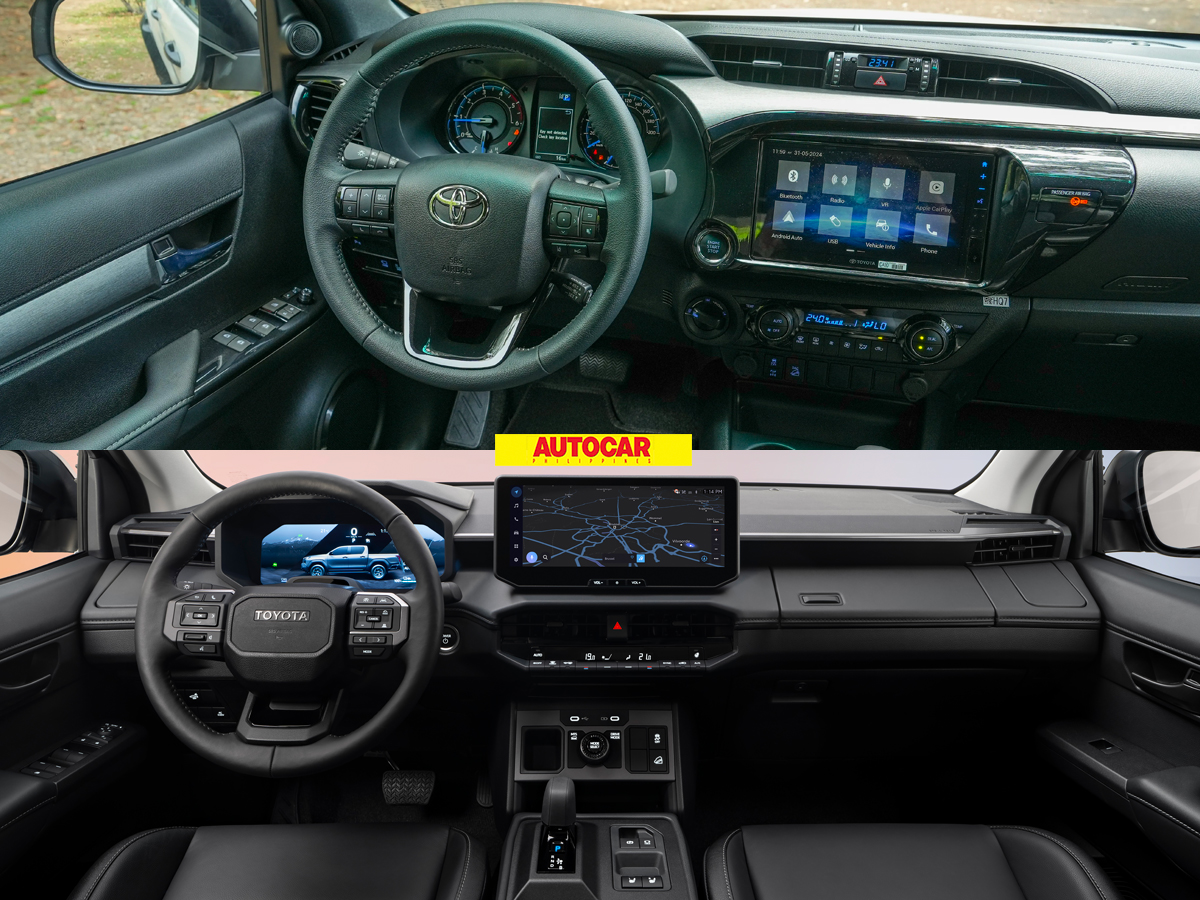
The old model’s interior presents a practical cabin with increasing levels of refinement. High trims bring better materials, more comfort features, and better tech amenities. Across the range, the old model’s interior is functional, well-proven, and for many users, a tried-and-true testament to Toyota’s built quality. The 9th generation elevates this with dual 12.3-inch digital displays, wireless charging, and more connected-car features. The best part is that it retains physical buttons and knobs, and switches for key features, suggesting that Toyota is aware that many drivers value practicality and durability that coexist with modern technology.
Technology
The old model Hilux offers a solid technology package for its era, featuring a modern infotainment system, driver-assist features in select trims via the Toyota Safety Sense advanced driver-assist system (ADAS) suite, and proven connectivity. It’s dependable and well-known in markets like the Philippines, where Toyota has strong service and parts support. The 9th generation, meanwhile, enters a new frontier. It’s the first body-on-frame Toyota to be available as a full EV. It offers physical and digital features upgrades, updated ADAS, and multi-terrain drive systems. Even the steering system gets updated with electrified steering control in some markets.
Safety
For safety, the 8th-generation Hilux boasts a strong credential – multiple airbags, ABS with EBD, stability control, hill-start assist, and in many markets, more feature-packed ADAS suites in higher trims. The 9th-generation Hilux builds upon this base with its expanded ADAS, which now includes low-speed acceleration suppression, proactive driving assist, and an emergency driving stop system. This upgraded ADAS suit can be updated in real-time using over-the-air updates.

Engine and powertrain
In markets like the Philippines, the 8th-generation Hilux is valued for its 2.4-liter and 2.8-liter turbocharged diesel engines, which are strong performers offering high torque, proven mechanical reliability, and backed by good service coverage. It’s offered with a 6-speed transmission available in manual or automatic, and is optioned with either 4×2 or 4×4 drive train, depending on the trim. The 9th generation takes a big leap forward with the addition of a mild-hybrid system and a full EV variant. The Hilux EV features a 59.2 kWh battery that runs two electric motors – one for the front and another for the rear axle, thus making the electric pickup an AWD unit, ready to face the challenge of continuing the storied legacy of the Hilux name for years to come.